image

일반 실험실 기법

Core 과학 실험의 시각적 시연

image
6개 컬렉션
15개 동영상

1700개 이상의 객관식 문제

목차

일반 실험실 기법

An Introduction to the Centrifuge
07:52
An Introduction to the Centrifuge

The centrifuge is an instrument used in nearly every research lab across the globe. Centrifugation is the process by which a centrifuge is used to separate components of a complex mixture. By spinning laboratory samples at very high speeds, the components of a given mixture are subjected to centrifugal force, which causes more dense particles to migrate away from the axis of rotation and lighter ones to move toward it. These particles can sediment at the bottom of the tube into what’s...

Video Duration: 7 minutes and 52 seconds
0 조회수
Introduction to the Microplate Reader
07:51
Introduction to the Microplate Reader

The microplate reader is a multimodal instrument that allows for a variety of experiments to be performed and measured simultaneously. Microplate readers can make absorbance, fluorescence and luminescence measurements. Multiwell plates are integral to the microplate reader and allow for many experiments to be performed at once. Regardless of the assay type, experiments on the plate reader utilize a standard curve to determine the experimental values. This curve uses samples of known...

Video Duration: 7 minutes and 51 seconds
0 조회수
Understanding Concentration and Measuring Volumes
08:51
Understanding Concentration and Measuring Volumes

Solutions are utilized to some degree in almost all biological research applications. Therefore understanding how to measure and manipulate them is imperative to any experiment. In this video, concepts in preparing solutions are introduced. Solutions consist of a solute dissolved in solvent to yield a homogeneous mixture of molecular substances. Solutions are generally identified by their components and corresponding concentrations. Concentrated solutions are diluted through various...

Video Duration: 8 minutes and 51 seconds
0 조회수
Making Solutions in the Laboratory
07:27
Making Solutions in the Laboratory

The ability to successfully make solutions is a basic laboratory skill performed in virtually all biological and chemical experiments. A solution is a homogenous mixture of solute dissolved in bulk liquid known as the solvent. Solutions can be described by their solute concentration, a measure of how much solute is present per unit of solution. In this video, a step-by-step procedure for how to make a water-based, or aqueous, solution for biological applications is presented. The video...

Video Duration: 7 minutes and 27 seconds
0 조회수
An Introduction to the Micropipettor
09:15
An Introduction to the Micropipettor

The micropipettor is a common laboratory instrument used for transferring microvolumes of liquid solutions. Micropipettors come in a range of sizes for the accurate movement of volumes between 0.5 and 5000 μl and each instrument requires one of three different sized disposable tips. Micropipettors work by displacing air from the pipette shaft, allowing the liquid to be drawn into the resulting vacuum. Their uses include transferring cell suspensions for a variety of cell-based assays, loading...

Video Duration: 9 minutes and 15 seconds
0 조회수
Introduction to Serological Pipettes and Pipettors
06:35
Introduction to Serological Pipettes and Pipettors

The serological pipette is frequently used in the laboratory for transferring milliliter volumes of liquid, from less than 1 ml to up to 50 ml. The pipettes can be sterile, plastic, and disposable or sterilizable, glass and reusable. Both kinds of pipettes use a pipet-aid, for the aspiration and dispensation of liquids. Different sizes of pipettes can be used with the same pipet-aid for a variety of experimental assays. For example, serological pipettes are useful for mixing chemical solutions...

Video Duration: 6 minutes and 35 seconds
0 조회수
분젠 버너 소개
07:04
분젠 버너 소개

1854년 로버트 분슨(Robert Bunsen)이 선정하고 공동 설계한 분젠 버너는 뜨겁고 그을음이 없는 비조명불꽃을 생산하는 일반적인 실험실 장비입니다. Bunsen 버너는 연소 전에 중앙 배럴에 가스와 산소를 혼합하여 불꽃을 일으킬 수 있도록 합니다. 분젠 버너를 조작하면 화염의 크기와 온도를 모두 제어할 수 있습니다. 다른 용도 중, 분젠 버너 불꽃의 열은 화염 위의 공간을 가열하고 그 아래 쿨러 공기에서 공기 중의 미립자를 들어 올리는 대류 전류를 만드는 데 사용할 수 있습니다, 이 작업 영역멸을 유지. 화염으로 작업하려면 추가주의가 필요합니다. 항상 분젠 버너를 점화하기 전에 느슨한 머리, 의류 또는 액세서리를 확보하고 항상 소화기 및 / 또는 화재 담요와 같은 적절한 안전 장비를 손에 가지고 있어야합니다. Bunsen 버너를 사용하는 방법과 손에 어떤 안전 장비를 사용하는 방법을 이해하는 데 시간이 걸리면 안전과 자신감을 가지고이 유용한 실험실 도구를 작동 할 수...

Video Duration: 7 minutes and 4 seconds
0 조회수
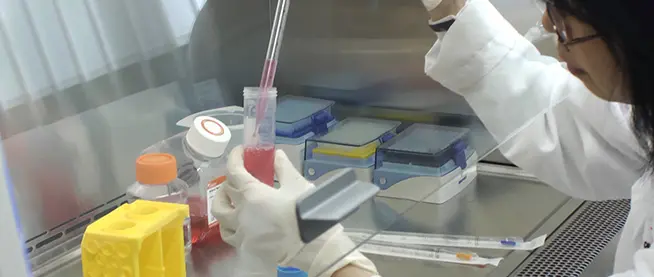
An Introduction to Working in the Hood
07:07
An Introduction to Working in the Hood

Hoods are a common class of instrument, which act as a protective enclosure for various types of laboratory experiments. They serve to shield experimental samples from the environment, as well as to protect the researcher from hazardous or infectious samples. “The Hood” is a term that can include laminar flow benches, fume hoods, as well as tissue culture hoods or biosafety cabinets. All hoods operate based on the principle of laminar flow and have the same basic components, including a...

Video Duration: 7 minutes and 7 seconds
0 조회수
Measuring Mass in the Laboratory
08:00
Measuring Mass in the Laboratory

The analytical balance is the common piece of equipment in the scientific laboratory. These highly precise instruments can measure down to ten thousandths or even hundred thousandths of a gram. The triple beam balance is a type of scale that uses counterweights on a three rider beams to counterbalance the sample in the pan. On the other hand, modern analytical balances use a complex system of electronic sensors to accurately mass a substance. The analytical balance is so sensitive that it...

Video Duration: 8 minutes
0 조회수
Introduction to the Spectrophotometer
07:38
Introduction to the Spectrophotometer

The spectrophotometer is a routinely used instrument in scientific research. Spectrophotometry is the quantitative measurement of how much a chemical substance absorbs light by passing a beam of light through the sample using a spectrophotometer. In this video, basic concepts in spectrophotometry, including transmittance, absorbance and the Beer-Lambert Law are reviewed in addition to the components of the spectrophotometer. These concepts provide a foundation for how to determine the...

Video Duration: 7 minutes and 38 seconds
0 조회수
무료 샘플
Histological Sample Preparation for Light Microscopy
09:27
Histological Sample Preparation for Light Microscopy

Histology is the study of cells and tissues, which is typically aided by the use of a light microscope. The preparation of histological samples can vary greatly based on the inherent properties of the samples such as size and hardness as well as expected post-processing which includes planned staining techniques or other down-stream applications. As described in this video, specimen preparation typically begins with a fixation procedure to prevent degradation of the sample by naturally...

Video Duration: 9 minutes and 27 seconds
0 조회수
Introduction to Fluorescence Microscopy
09:22
Introduction to Fluorescence Microscopy

Fluorescence microscopy is a very powerful analytical tool that combines the magnifying properties of light microscopy with visualization of fluorescence. Fluorescence is a phenomenon that involves absorbance and emission of a small range of light wavelengths by a fluorescent molecule known as a fluorophore. Fluorescence microscopy is accomplished in conjunction with the basic light microscope by the addition of a powerful light source, specialized filters, and a means of fluorescently...

Video Duration: 9 minutes and 22 seconds
0 조회수
Introduction to Light Microscopy
08:35
Introduction to Light Microscopy

The light microscope is an instrument used by researchers in many different fields to magnify specimens to as much as a thousand times their original size. In its simplest form, it is composed of a clear lens that magnifies the sample and a light source to illuminate it. However, most light microscopes are much more complex and house numerous fine-tuned lenses with tightly controlled dimensions all within the body of the microscope itself and in components such as the objectives and eyepieces.

Video Duration: 8 minutes and 35 seconds
0 조회수
Regulating Temperature in the Lab: Preserving Samples Using Cold
08:07
Regulating Temperature in the Lab: Preserving Samples Using Cold

Preservation of laboratory samples, specimens, and reagents using extreme cold is routinely performed in biomedical research labs. This video will discuss some of the methods for keeping laboratory samples cold and will explain the correct cooling method to use for each experimental requirement. For example, cooling agents, such as ice and dry ice, are typically used when keeping samples cold during experiments. This video discusses the physical properties of the most commonly used cooling...

Video Duration: 8 minutes and 7 seconds
0 조회수
Regulating Temperature in the Lab: Applying Heat
08:29
Regulating Temperature in the Lab: Applying Heat

Although many experimental assays are performed at room temperature (RT; ~20-25°C), it is not uncommon for experiments, or parts of experiments, to require some type of temperature regulation. This video discusses the different reasons for and temperatures at which a scientist may want to “keep things warm”. For example, sometime, cells need to be cultured in an environment close to body temperature (~37°C), protein structure needs to be modified (>56°C), or reagents and solutions need to...

Video Duration: 8 minutes and 29 seconds
0 조회수

JoVE Science Education을 선택하는 이유

JoVE Science Education을 선택하는 이유

학생들의 더 나은 학습 성과

동료 검토 연구에 따르면 JoVE 동영상 사용 후 학생들의 시험 성적이 2배 높아졌습니다.

더 쉬운 교육

학생의 90%가 JoVE 동영상을 사용할 때 과목에 대한 참여도가 높아진다고 보고했습니다.

시각화된 실험

Core 실험과 이론에 대한 단계별 비디오 시연.

학생들의 더 나은 학습 성과

동료 검토 연구에 따르면 JoVE 동영상 사용 후 학생들의 시험 성적이 2배 높아졌습니다.

더 쉬운 교육

학생의 90%가 JoVE 동영상을 사용할 때 과목에 대한 참여도가 높아진다고 보고했습니다.

시각화된 실험

Core 실험과 이론에 대한 단계별 비디오 시연.