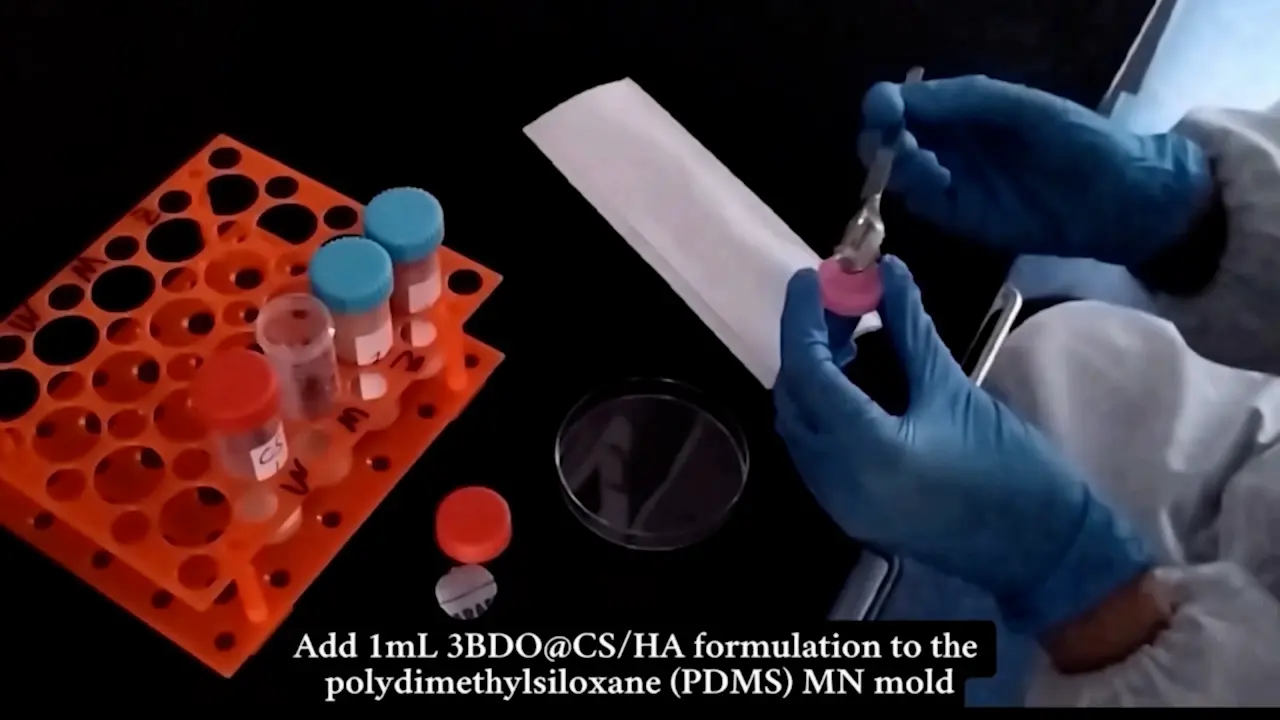
This protocol describes the fabrication, characterization, and application of 3BDO-loaded dissolvable microneedle patches for transdermal drug delivery in a mouse hair-regrowth model.
このコンテンツを表示するには、JoVEへの購読が必要です。 または、無料トライアルをお申し込みください。
方法論記事
Fabrication and Characterization of 3BDO-Loaded Dissolvable Microneedle Patches for Hair Regrowth in C57BL/6 Mice
* These authors contributed equally
この記事について
サマリー
要約
Conventional treatments for androgenetic alopecia (AGA) have limitations, motivating alternative delivery approaches. This protocol describes the fabrication, characterization, and application of 3BDO-loaded hyaluronic acid/chitosan (HA/CS) dissolvable microneedle (MN) patches in a C57BL/6 mouse hair-regrowth model. The method uses a two-step molding process in a polydimethylsiloxane (PDMS) mold to concentrate 3BDO in the needle tips while forming a drug-free HA/CS backing layer. The patch is characterized by scanning electron microscopy (SEM) imaging, mechanical testing, skin insertion and dissolution testing, in vitro release testing, antibacterial assays, cytotoxicity testing, and in vivo hair-regrowth assessment. Upon insertion, the MN tips dissolve, releasing 3BDO locally. In vivo evaluation showed that the 3BDO-loaded MN group had more uniform hair regrowth than the subcutaneous injection and control groups tested. This protocol also supports assessment of patch morphology, insertion performance, and local biocompatibility. This method provides a preclinical workflow to evaluate MN-mediated delivery of 3BDO for hair-regrowth applications.
概要
Androgenetic alopecia (AGA) is one of the most common clinical alopecic disorders, characterized primarily by progressive thinning and loss of scalp hair. Its lifetime prevalence remains persistently high among men, making it a critical health issue that demands urgent resolution1,2. Currently, clinical treatments for AGA are mainly categorized into pharmacologic interventions and surgical transplantation, both of which have substantial drawbacks. First-line therapeutic drugs such as finasteride and minoxidil exhibit certain therapeutic effects but are associated with definite adverse reactions like sexual dysfunction, scalp pruritus, and scalp dryness1,3. Although hair transplantation can achieve local hair regeneration, it is limited by high treatment costs, insufficient hair quantity in donor areas, and fluctuating graft survival rates, rendering it difficult to be widely popularized in clinical practice1. Given these limitations, there is a need for novel therapeutic strategies combining effectiveness, safety, and patient compliance.
3BDO is a small-molecule mTOR activator in competition with rapamycin4. It has been widely used as an autophagy inhibitor in various systems5,6,7. For instance, long-term treatment with 3BDO could improve memory function by diminishing the number of autophagosomes8. In addition, accumulating evidence suggests that 3BDO may act independently as an mTOR activator. For example, 3BDO impeded endothelial cell death and atherosclerosis development in mice, independently of mTOR activity9. However, its potential role in hair follicle growth has not been reported. Notably, in our preliminary studies, 3BDO was found to promote hair regrowth. However, traditional topical drug delivery methods have obvious limitations. The stratum corneum of the skin limits transdermal efficiency, making it difficult to deliver drugs to the hair follicle target site in the dermis. Although transdermal gels can prolong drug retention time, they may leave undesirable residue. The clinical efficacy of both treatment strategies mentioned above remains suboptimal10,11.
Microneedles (MNs) are a novel, painless drug-delivery technology whose core advantage lies in their ability to easily penetrate the stratum corneum and accurately deliver drugs to the perifollicular microenvironment at the junction of the epidermis and dermis. Additionally, MNs feature convenient use, minimal invasiveness, and reasonable cost12,13,14. To address the transdermal delivery bottleneck of topical 3BDO, an MN patch was developed using hyaluronic acid (HA) as the matrix and chitosan (CS) as the functional component. The incorporation of CS is intended to provide a functional component with antibacterial potential. Moreover, the application of HA to alopecic mouse skin could significantly stimulate hair follicle development15. Therefore, this protocol describes the fabrication and characterization of a 3BDO-loaded dissolvable MN system and its application in a depilated C57BL/6 mouse hair-regrowth model. This model is useful for evaluating hair-regrowth responses after depilation, but it does not by itself establish clinical efficacy for AGA.
アクセスが制限されています。このコンテンツを表示するにはログインするか、トライアルを開始してください。
プロトコル
The study was approved by the animal ethics committee of the Shandong First Medical University & Shandong Academy of Medical Sciences (W202112030345). All methods were performed in accordance with the relevant guidelines and regulations.
1. Fabrication of 3BDO@MN patches
- Preparation of CS/HA formulation
- Weigh 1 g of CS powder (degree of deacetylation ≥ 95%) and add it to 20 mL of distilled water, followed by stirring at room temperature (RT) for 10 min.
- Continue adding 0.4 mL of 2% (v/v) acetic acid solution (molecular weight 60.05) and continue stirring for 2 h.
CAUTION: Concentrated acetic acid is corrosive. Perform the dilution and handling in a fume hood, and wear disposable gloves and goggles to prevent contact with skin and mucous membranes. - Continue with the addition of 2 g of HA powder and then centrifuging the mixed formulation at 1,207 × g (approximately 3,000 rpm) for 5 min to ensure full dissolution.
NOTE: The CS/HA formulation should be freshly prepared, and it can be kept in a 4 °C refrigerator for no more than 24 h.
- Preparation of 3BDO-loaded CS/HA formulation
- Add the predissolved 3BDO solution (2 mg/mL) into dimethyl sulfoxide (DMSO)
CAUTION: DMSO is skin-permeable. Wear gloves during operation to avoid direct skin contact and add it to the CS/HA formulation. Mix it to ensure full dissolution. - Centrifuge the mixed formulation at 1,207 × g for 5 min to remove any trapped air bubbles.
NOTE: If bubbles persist after centrifugation, let the formulation stand for 5 min and then centrifuge again.
- Add the predissolved 3BDO solution (2 mg/mL) into dimethyl sulfoxide (DMSO)
- Fabrication of 3BDO@MN patches
- Use a polydimethylsiloxane (PDMS) MN mold, featuring a 20 × 20 array of conical tips with a height of 600 µm, a base diameter of 250 µm, and a pitch of 550 µm.
- Treat the surface of the PDMS mold using a plasma cleaner to render it completely hydrophilic.
- Add 1 mL of 3BDO@CS/HA formulation to the PDMS MN mold. Place the mold in a vacuum chamber and apply a vacuum for 10 min to facilitate infiltration of the viscous formulation into the micro-cavities.
- Centrifuge the mold at 134 × g for 5 min at RT to ensure the formulation fills all cavities. Use a sterile metal scraper to carefully remove excess formulation from the mold surface, leaving a perfectly flat plane.
- Dispense the CS/HA matrix blend without 3BDO onto the mold surface. Centrifuge at 134 × g for 5 min at RT to form a uniform backing layer.
- Place the mold in an oven at 36 °C and 37% humidity and dry it overnight (approximately 12–16 h).
- Peel off the fully dried MN patch from the mold after the mold cools to RT.
NOTE: Keep the fabricated 3BDO@MN patches stored in a 4 °C refrigerator until ready for use.
2. Characterization of 3BDO@MN patches
- Mount the prepared 3BDO@MN patch onto a stub using double-sided conductive carbon tape.
- Sputter-coat the mounted sample with a thin layer of gold (or platinum) to enhance electrical conductivity.
- Load the specimen stub into the vacuum chamber of a field-emission scanning electron microscope (FE-SEM).
- Adjust the accelerating voltage and working distance to obtain high-resolution imaging. Observe the overall array morphology and the fine surface topography of individual MNs.
- Acquire representative SEM micrographs. Measure the MN length and tip diameter.
- Mechanical strength testing
- Place the MN patch flat onto the sample test stage of a texture analyzer. Ensure that the substrate is perfectly flat, and the needle tips are facing directly upward.
- Attach a flat cylindrical probe (25 mm in diameter) securely to the load cell of the instrument.
- Lower the probe vertically until it is positioned just above the MN tips. Avoid any physical contact between the probe and the tips prior to the test.
- Set the specific testing parameters in the software: set the downward test speed to 0.05 mm/s, and set the target displacement distance to 0.7 mm.
- Dissolution test
- Spread rat dorsal skin on the dissection board and blot the skin surface dry. Keep skin flat and wrinkle-free.
- Place dry MN patches with needle tips facing down on the skin surface, and apply uniform vertical pressure to ensure insertion of the MNs into the skin.
- Remove the patches from the skin at predetermined time intervals (5, 10, 30, and 60 s) and dry for 5 min.
- Observe the residual morphology by SEM under the same imaging conditions.
- In vitro drug release assays
- Add 500 µL of phosphate-buffered saline (PBS) to each well of a 6-well plate. Place the 3BDO-loaded MNs in each well so that they contact the PBS.
- Incubate the plates at RT. At each time point, collect 500 µL of PBS for quantification of the 3BDO concentration.
- Immediately replenish each well with 500 µL of fresh PBS to maintain sink conditions.
- Calculate the cumulative percentage of 3BDO released based on the total drug loading initially in the MNs.
- Antibacterial assays
- Remove bacterial cell stocks (E. coli and Staphylococcus aureus) from storage at -80 °C, and add 10 µL of each bacterial cell stock into 5 mL of LB medium.
- Incubate the inoculated medium in an incubator shaker at 37 °C and 250 rpm for approximately 16 h (overnight).
- Adjust the bacterial culture with LB medium to an initial OD620 of 0.01.
- Dilute the CS stock solution with sterile water to prepare CS solutions at six concentrations (1, 5, 10, 50, 100, and 500 mg/mL), with three replicates for each concentration.
- Divide the samples into three groups: blank group, control group, and CS group. For the blank group, add 200 µL of LB. For the control group, add 180 µL of bacterial solution and 20 µL of sterile water. For the CS group, add 180 µL of bacterial solution and 20 µL of the corresponding concentration of CS solution.
- Incubate at 37 °C for 20 h.
- Measure and record the OD620 of each well of the 96-well plate on an absorbance plate reader at 0 h and 20 h.
- Cytotoxicity evaluations
- Seed 100 µL of epidermal or dermal cell suspension into a 96-well plate (2 × 10³ cells per well).
- Add 10 µL of the respective treatments to the designated wells to establish four groups: a control group (culture medium), a 3BDO group (final concentration of 1 µM), an MN extract group, and a 3BDO+MN extract group, with 3 replicates for each group.
- Incubate at 37 °C, 5% CO₂ for 24 h.
- Add 10 µL of Cell Counting Kit-8 (CCK-8) working solution to each well.
NOTE: Avoid creating bubbles in the wells, as they may affect absorbance readings. - Incubate at 37 °C, 5% CO₂ for 2 h.
- Read the absorbance at 450 nm for all wells using a microplate spectrophotometer.
- Analyze the data and calculate the cell survival rate.
3. Animal experiments
- Experimental animal preparation and treatment
- Anesthetize 7-week-old male C57BL/6 mice with isoflurane, and provide thermoregulation during anesthesia.
CAUTION: Isoflurane is a volatile anesthetic. Operate in a well-ventilated environment to avoid excessive inhalation. - Apply ophthalmic lubricant to the eyes of the mice to protect them from drying.
- Shave the dorsal hair of the mice using an electric shaver, with a shaved area of approximately 2 × 2 cm2.
- Apply the depilatory cream, wait 5–10 s, then wipe it off. Wipe the skin with a saline swab to remove any remaining depilatory cream and hair.
- Trim the MN patches and set them aside.
- Randomly divide the shaved mice into five groups (n = 5 per group) and treat as follows:
- Untreated control group: only shave the hair without any treatment.
- Blank MN patch group: treat the shaved skin with MN patches without 3BDO following the same schedule as the 3BDO@MN group.
- 3BDO@MN patch group: treat the shaved skin with 3BDO@MN patches on day 1, 3, 5, 7, 9, 11, and 13.
- PBS subcutaneous injection group: administer subcutaneous injection of PBS solution to the shaved dorsal area of mice daily.
- 3BDO subcutaneous injection group: administer subcutaneous injection of 3BDO solution to the shaved dorsal area of mice daily.
- Place the 3BDO@MN patches on the shaved skin, and apply uniform vertical pressure to ensure the insertion of the MNs into the skin. Secure the 3BDO@MN patches with an elastic bandage and use a straight clamp to hold the bandage in place.
NOTE: The different dosing schedules were selected according to the distinct delivery characteristics of each strategy: the 3BDO@MN patch provides localized sustained release, whereas subcutaneous injection delivers 3BDO as a bolus dose. - Observe the mice throughout the experiment to ensure they fully recover from anesthesia.
- Anesthetize 7-week-old male C57BL/6 mice with isoflurane, and provide thermoregulation during anesthesia.
- Sample collection and hair growth evaluation
- Photograph the dorsal skin of the mice every day to record hair growth.
- Evaluate hair regrowth by measuring the hair shaft diameter, hair coverage, and hair density on day 15. Quantify the percentage of hair coverage in the treated area using ImageJ software.
アクセスが制限されています。このコンテンツを表示するにはログインするか、トライアルを開始してください。
結果
This protocol presents the fabrication and characterization of the 3BDO@MN patch. Figure 1 shows the schematic of the fabrication process for the 3BDO@MN patch. 3BDO was mixed into the CS/HA formulation, and the matrix blend was then added to the PDMS MN mold and centrifuged to fill the needle tips. The CS/HA matrix blend without 3BDO was added onto the mold surface and centrifuged to fill the backing layer. After complete drying, the patches were peeled off to obtain the 3B...
アクセスが制限されています。このコンテンツを表示するにはログインするか、トライアルを開始してください。
ディスカッション
Currently, clinical treatments for AGA are mainly categorized into pharmacologic interventions and surgical transplantation. In this study, 3BDO-loaded MNs promoted hair regrowth in a C57BL/6 mouse model. However, conventional drug delivery methods have limitations, such as uneven drug distribution. The key protocol in this study is a two-step method to fabricate 3BDO-loaded MNs. HA and CS are the primary components of MNs. Several critical steps require attention to ensure MN quality.
First, ...
アクセスが制限されています。このコンテンツを表示するにはログインするか、トライアルを開始してください。
開示事項
The authors have no conflicts of interest to declare.
謝辞
This work was supported by the National Natural Science Foundation of China (82273554), the Medical and Health Science and Technology Development Project of Shandong Province (No.202304030716), the National College Students Innovation and Entrepreneurship Training Program of China (No. 202410439001), and the Tai’an Science and Technology Innovation Development Project (No. 2023NS232).
アクセスが制限されています。このコンテンツを表示するにはログインするか、トライアルを開始してください。
材料
| 名前 | 会社 | カタログ番号 | コメント |
|---|---|---|---|
| 3BDO | Yuanye Bio-Technology Co., Shanghai, China | 890405-51-3 | Preparation of 3BDO-loaded CS/HA formulation |
| 6-well plate | Corning Incorporated, USA | REF 3516 | antibacterial assay and in vitro drug release assay |
| 75% ethanol | Shandong Lircon Medical Technology Co., Ltd. | 1202050004 | Disinfection |
| 96-well plate | Corning Incorporated, USA | REF3599 | cell cytotoxicity evaluations and antibacterial assay |
| C57BL/6 mice | Charles River Laboratories | 7 weeks | animal experiments |
| Cell Counting Kit-8 (CCK-8) | Dojindo, Japan | CK04 | cytotoxicity evaluations |
| Centrifuge | Thermo Fisher Scientific | 75007204 | Formulation centrifuge |
| Chitosan (CS) | Shanghai Macklin Biochemical Co.,Ltd | 9012-76-4 | Preparation of CS/HA formulation |
| Depilatory cream | Veet | 3059944023307 | Depilation |
| Dimethyl sulfoxide (DMSO) | Shanghai Macklin Biochemical Co.,Ltd | 67-68-5 | Preparation of 3BDO-loaded CS/HA formulation |
| Electronic balance | Radwag | AS 220.R2 | Powder weighing |
| Escherichia coli (E. coli) | ATCC | / | antibacterial assay |
| Hyaluronic Acid (HA) powder | Bloomage Biotechnology Co. China | 9067-32-7 | Preparation of CS/HA formulation |
| ImageJ software | National Institutes of Health | / | Statistical analysis |
| Incubator shaker | Thermo Scientific | 50163013 | bacterial incubation |
| Isoflurane vaporizer | Gene&I | AMS | animal anesthesia |
| LB medium | Sigma Life Science | L3022 | antibacterial assay |
| Magnetic stirrer | Hangzhou MiuLab Instrument Co., Ltd. | SP-16 | Formulation stirring |
| Multiskan SkyHigh microplate spectrophotometer | Thermo Fisher Scientific | / | OD measurement |
| Oven | Shanghai Huitai Instrument Manufacturing Co.,Ltd | DHG-9260A | Microneedle drying |
| Parafilm M | Amcor | PM-996 | Microneedle sealing |
| Phosphate buffer solution (PBS) | Biosharp | BL302A | in vitro drug release assay |
| Staphylococcus aureus (S. aureus) | ATCC | / | antibacterial assay |
| Universal TA texture analyzer | Shanghai Tengba Instrument Technology Co., Ltd | / | Mechanical strength testing |
| Vacuum chamber | Shanghai Huitai Instrument Manufacturing Co.,Ltd | DZF-6050 | Vacuum drying |
参考文献
- Zhou C, Li X, Wang C, Zhang J. Alopecia areata: an update on etiopathogenesis, diagnosis, and management. Clin Rev Allergy Immunol. 2021;61(3):403-23.
- Rudnicka L. Hair loss is a symptom of many complex medical and psychological problems. J Eur Acad Dermatol Venereol. 2023;37(8):1460-1.
- Alessandrini A, Bruni F, Piraccini BM, Starace M. Common causes of hair loss: clinical manifestations, trichoscopy and therapy. J Eur Acad Dermatol Venereol. 2021;35(3):629-40.
- Zhao X et al. Long noncoding RNA CA7-4 promotes autophagy and apoptosis via sponging MIR877-3P and MIR5680 in high glucose-induced vascular endothelial cells. Autophagy. 2020;16(1):70-85.
- Wang L et al. An effective pharmacological hydrogel induces optic nerve repair and improves visual function. Sci China Life Sci. 2024;67(3):529-42.
- Wei Y et al. Midline-1 regulates effector T cell motility in experimental autoimmune encephalomyelitis via mTOR/microtubule pathway. Theranostics. 2024;14(3):1168-80.
- Gao Y et al. Rheb1 promotes tumor progression through mTORC1 in MLL-AF9-initiated murine acute myeloid leukemia. J Hematol Oncol. 2016;9:36.
- Wei L et al. A butyrolactone derivative 3BDO alleviates memory deficits and reduces amyloid-beta deposition in an AbetaPP/PS1 transgenic mouse model. J Alzheimers Dis. 2012;30(3):531-43.
- Meng N et al. Heterogeneous nuclear ribonucleoprotein E1 regulates protein disulphide isomerase translation in oxidized low-density lipoprotein-activated endothelial cells. Acta Physiol (Oxf). 2015;213(3):664-75.
- Clavel C et al. Sox2 in the dermal papilla niche controls hair growth by fine-tuning BMP signaling in differentiating hair shaft progenitors. Dev Cell. 2012;23(5):981-94.
- Yang CC, Cotsarelis G. Review of hair follicle dermal cells. J Dermatol Sci. 2010;57(1):2-11.
- Jin Y et al. Multifunctional microneedle patches loaded with engineered nitric oxide-releasing nanocarriers for targeted and synergistic chronic wound therapy. Adv Mater. 2025;37(5):e2413108.
- Wu H et al. Ultrasonic hollow microneedle array (USHM) for androgenetic alopecia treatment through modulating the expression of hair-growth-associated genes. ACS Appl Mater Interfaces. 2025;17(14):21419-30.
- Cao Y et al. Dissolvable microneedle-based wound dressing transdermally and continuously delivers anti-inflammatory and pro-angiogenic exosomes for diabetic wound treatment. Bioact Mater. 2024;42:32-51.
- Liu J et al. Medium-molecular weight hyaluronic acid orchestrates hair follicle regeneration via CD44/AKT-driven endogenous ROS activation of beta-catenin. Int J Biol Macromol. 2026;360:151752. doi:10.1016/j.ijbiomac.2026.151752.
- Nareswari A et al. Development and validation of a C57BL/6 mouse model of androgenetic alopecia through testosterone propionate induction. Trends Sci. 2026;23(8):12711.
- Liu M, He G, Wang F, Wang Y. In vivo non-invasive observation of dynamic changes in hair shaft, melanin, and collagen during the C57BL/6 follicle cycle. bioRxiv. 2025. doi:10.1101/2025.09.15.676351.
- Vora LK et al. Long-acting microneedle formulations. Adv Drug Deliv Rev. 2023;201:115055.
- Xiang H et al. Dissolving microneedles for alopecia treatment. Colloids Surf B Biointerfaces. 2023;229:113475.
- Xiao T et al. Microneedle assisted delivery of epidermal and dermal stem cells to promote hair growth. J Mater Sci. 2024;59(19):8427-40.
アクセスが制限されています。このコンテンツを表示するにはログインするか、トライアルを開始してください。
再版と許可