image

物理学 II

重要な科学実験の視覚的デモンストレーション

image
2コレクション
15 本の動画

1700以上の多肢選択問題

目次

物理学 II

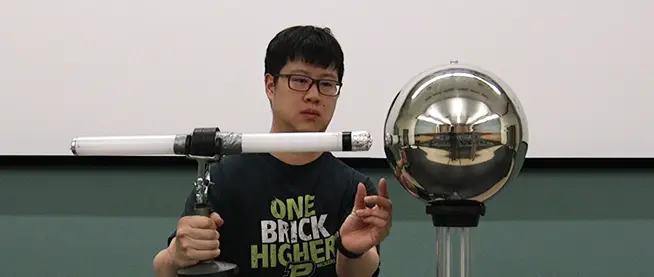
Electric Fields
10:23
Electric Fields

Source: Yong P. Chen, PhD, Department of Physics & Astronomy, College of Science, Purdue University, West Lafayette, IN An electric field is generated by a charged object (referred to as the source charge) in the space around it, and represents the ability to exert electric force on another charged object (referred to as the test charge). Represented by a vector at any given point in the space, the electric field is the electrical force per unit test charge placed at that point (the force...

Video Duration: 10 minutes and 23 seconds
0 回視聴
Electric Potential
06:50
Electric Potential

Source: Yong P. Chen, PhD, Department of Physics & Astronomy, College of Science, Purdue University, West Lafayette, IN Electric potential, also known as "voltage", measures the electric potential energy per unit charge. Electric field is a scalar quantity and is fundamental to many electrical effects. Like potential energy, what is physically meaningful is the difference in the electric potential. For example, the spatial variation in the electric potential is related to the electric...

Video Duration: 6 minutes and 50 seconds
0 回視聴
無料サンプル
Magnetic Fields
10:04
Magnetic Fields

Source: Yong P. Chen, PhD, Department of Physics & Astronomy, College of Science, Purdue University, West Lafayette, IN Magnetic fields can be generated by moving charges, such as an electrical current. The magnetic field generated by a current can be calculated from the Maxwell equation. In addition, magnetic objects such as bar magnets can also generate magnetic fields due to microscopic dynamics of charges inside the material. Magnetic fields will exert magnetic force on other moving...

Video Duration: 10 minutes and 4 seconds
0 回視聴
Electric Charge in a Magnetic Field
09:12
Electric Charge in a Magnetic Field

Source: Andrew Duffy, PhD, Department of Physics, Boston University, Boston, MA This experiment duplicates J.J. Thomson's famous experiment at the end of the 19th century, in which he measured the charge-to-mass ratio of the electron. In combination with Robert A. Millikan's oil-drop experiment a few years later that produced a value for the charge of the electron, the experiments enabled scientists to find, for the first time, both the mass and the charge of the electron, which are key...

Video Duration: 9 minutes and 12 seconds
0 回視聴
Investigation Ohm's Law for Ohmic and Nonohmic Conductors
12:41
Investigation Ohm's Law for Ohmic and Nonohmic Conductors

Source: Andrew Duffy, PhD, Department of Physics, Boston University, Boston, MA This experiment investigates Ohm's law, which relates current, voltage, and resistance. One goal of the experiment is to become familiar with circuit diagrams and the terminology involved in basic circuits, such as resistor, resistance, current, voltage, and power supply. By the end of the experiment, familiarity is gained with how to wire up a circuit and how to measure both the current passing through a circuit...

Video Duration: 12 minutes and 41 seconds
0 回視聴
Series and Parallel Resistors
11:34
Series and Parallel Resistors

Source: Yong P. Chen, PhD, Department of Physics & Astronomy, College of Science, Purdue University, West Lafayette, IN This experiment demonstrates how current is distributed in resistors connected in series or parallel, and thus describes how to calculate the total "effective" resistance. Using Ohm's law, it possible to convert between the voltage and current through a resistance, if the resistance is known. For two resistors connected in series, (meaning that they are wired one after the...

Video Duration: 11 minutes and 34 seconds
0 回視聴
Capacitance
08:56
Capacitance

Source: Yong P. Chen, PhD, Department of Physics & Astronomy, College of Science, Purdue University, West Lafayette, IN This experiment will use commercial capacitors and a parallel plate capacitor to demonstrate the concept of capacitance. A capacitor stores opposite charges on two conductors, for example two opposite metal plates, leading to a potential difference (voltage drop) between the two conductors. The amount of charge on each conductor is proportional to this voltage drop, with...

Video Duration: 8 minutes and 56 seconds
0 回視聴
Inductance
11:33
Inductance

Source: Yong P. Chen, PhD, Department of Physics & Astronomy, College of Science, Purdue University, West Lafayette, IN This experiment will use inductive coils to demonstrate the concept of inductor and inductance. Magnetic induction will be demonstrated using a rod magnet inserted into or extracted away from the core of a coil to induce a transient electromotive force (emf) voltage in the coil, measured by a voltmeter. This experiment will also demonstrate the mutual inductance between...

Video Duration: 11 minutes and 33 seconds
0 回視聴
RC/RL/LC Circuits
09:27
RC/RL/LC Circuits

Source: Yong P. Chen, PhD, Department of Physics & Astronomy, College of Science, Purdue University, West Lafayette, IN Capacitors (C), inductors (L), and resistors (R) are each an important circuit element with distinct behaviors. A resistor dissipates energy and obeys Ohm's law, with its voltage proportional to its current. A capacitor stores electrical energy, with its current proportional to the rate of change of its voltage, while an inductor stores magnetic energy, with its voltage...

Video Duration: 9 minutes and 27 seconds
0 回視聴
Semiconductors
12:36
Semiconductors

Source: Derek Wilson, Asantha Cooray, PhD, Department of Physics & Astronomy, School of Physical Sciences, University of California, Irvine, CA Semiconductors are materials whose ability to conduct an electrical current depends strongly on their temperature and level of impurity. The most common type of semiconductor material is crystalline silicon. Most pure semiconductors are not outstanding conductors; to improve conductivity, a pure semiconductor is often combined or "doped" with an...

Video Duration: 12 minutes and 36 seconds
0 回視聴
Photoelectric Effect
08:38
Photoelectric Effect

Source: Yong P. Chen, PhD, Department of Physics && Astronomy, College of Science, Purdue University, West Lafayette, IN Photoelectric effect refers to the emission of electrons from a metalwhen light is shining on it. In order for the electrons to be liberated from the metal, the frequency of the light needs to be sufficiently high such that the photons in the light have sufficient energy. This energy is proportional to the light frequency.The photoelectric effect provided the...

Video Duration: 8 minutes and 38 seconds
0 回視聴
Reflection and Refraction
13:59
Reflection and Refraction

Source: Derek Wilson, Asantha Cooray, PhD, Department of Physics & Astronomy, School of Physical Sciences, University of California, Irvine, CA Light travels at different speeds depending on the material through which it is propagating. When light travels from one material to another, it will either slow down or speed up. In order to conserve energy and momentum, the light must change the direction in which it propagates. This bending of light is known as refraction. Some fraction of the...

Video Duration: 13 minutes and 59 seconds
0 回視聴
Interference and Diffraction
08:41
Interference and Diffraction

Source: Yong P. Chen, PhD, Department of Physics & Astronomy, College of Science, Purdue University, West Lafayette, IN Interference and diffraction are characteristic phenomena of waves, ranging from water waves to electromagnetic waves such as light. Interference refers to the phenomenon of when two waves of the same kind overlap to give an alternating spatial variation of large and small wave amplitude. Diffraction refers to the phenomenon of when a wave passes through an aperture or...

Video Duration: 8 minutes and 41 seconds
0 回視聴
Standing Waves
09:32
Standing Waves

Source: Arianna Brown, Asantha Cooray, PhD, Department of Physics & Astronomy, School of Physical Sciences, University of California, Irvine, CA Standing waves, or stationary waves, are waves that appear not to propagate and are produced by the interference of two waves traveling in opposite directions with the same frequency and amplitude. These waves appear to vibrate up and down with no linear movement and are most easily identified in vibrating finite media like a plucked guitar string,...

Video Duration: 9 minutes and 32 seconds
0 回視聴
Sound Waves and Doppler Shift
09:12
Sound Waves and Doppler Shift

Source: Arianna Brown, Asantha Cooray, PhD, Department of Physics & Astronomy, School of Physical Sciences, University of California, Irvine, CA Waves are disturbances that propagate through a material medium or empty space. Light waves can travel through a vacuum and some forms of matter, and are transverse in nature, which means that the oscillations are perpendicular to the direction of propagation. However, sound waves are pressure waves that travel through an elastic medium like air,...

Video Duration: 9 minutes and 12 seconds
0 回視聴

JoVE Science Educationを選ぶ理由

JoVE Science Educationを選ぶ理由

学生の学習成果の向上

査読付き研究により、JoVE動画を使用した後、学生のテスト成績が2倍になったことが示されています。

より簡単な教育

学生の90%がJoVE動画を使用すると科目への関心が高まると報告しています。

視覚化された実験

主要な実験と理論のステップバイステップのビデオデモンストレーション。

学生の学習成果の向上

査読付き研究により、JoVE動画を使用した後、学生のテスト成績が2倍になったことが示されています。

より簡単な教育

学生の90%がJoVE動画を使用すると科目への関心が高まると報告しています。

視覚化された実験

主要な実験と理論のステップバイステップのビデオデモンストレーション。